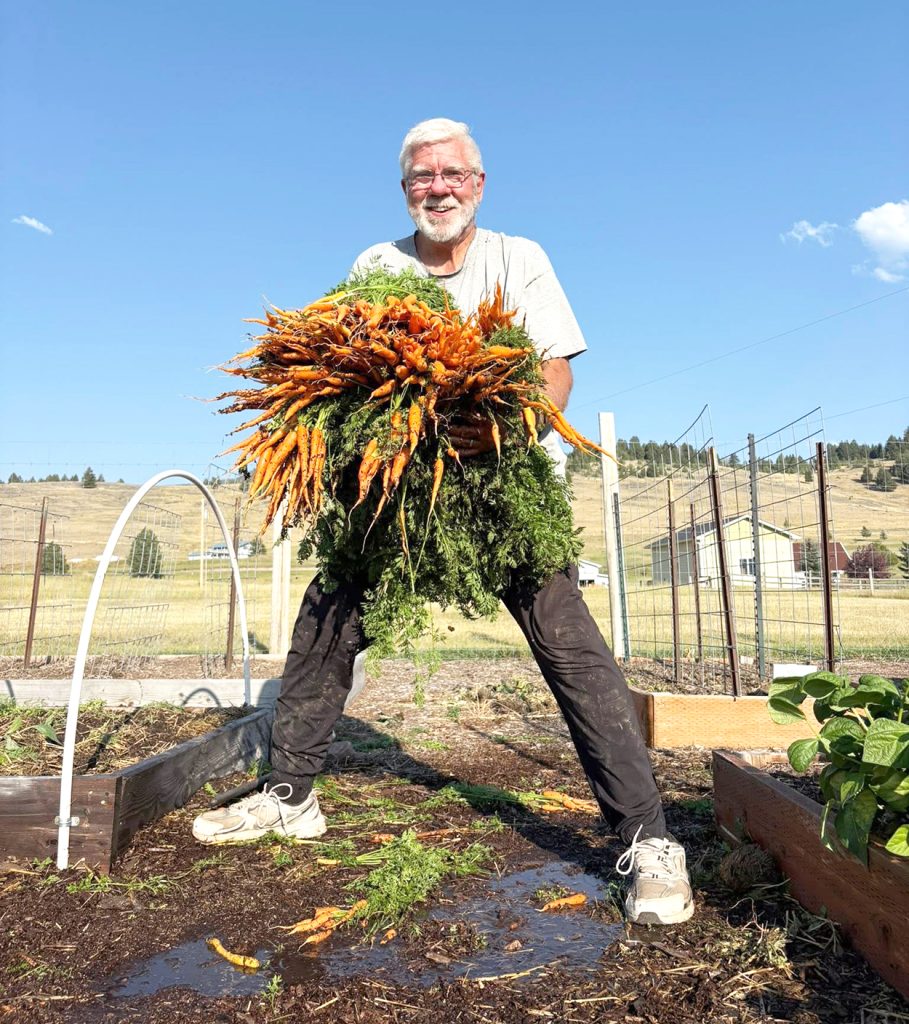
Mike Noblin holds up a bountiful carrot harvest from the raised bed gardens in Philipsburg in August. Photo courtesy of Mike Noblin.
Garden of Readin’
By Mike Noblin
Retired Horticulturist
Raised bed gardening is being utilized more every day, especially in the community gardens, especially here in Anaconda.
In 2023 I built the Philipsburg Community Gardens’ beds with really no knowledge of construction. Fortunately, I have some great neighbors who were willing to help install fence posts, and haul soil They had all of the equipment. All I have ever done in my life, is be around plants, whether it be ornamental landscape plants, vegetable production or digging up my parents’ backyard in Waukegan, Illinois. I was never interested in how to fix and maintain cars, like most teens did. After graduating college, we moved to Florida and I spent the next 30 years working with tropical and subtropical plants, in both residential and commercial settings.
I started my own business in lawn, shrub and indoor pest control, and sold the business in 2017, with the hopes of spending my time fly fishing, and trying to bag that trophy elk. There was something missing though. As great as that is, I wanted to give back and help others by doing what I know … growing vegetables.
Raised beds can really be any size or shape that you want. They are generally used most on small scales, where you may want to grow some lettuce or a few tomatoes in an area where you don’t have a lot of room. They are also used in areas of poor soil conditions, or where soil contamination from where mining has previously occurred. Growing vegetables in raised beds eliminates for the most part concerns of “bad soil”, by allowing you, the home gardener, to purchase bagged soils from your local hardware store, in combination with well-rotted manures and compost. These provide crucial microbial activity not found in bagged soils.
Although you are paying more initially by purchasing pre-made soil mixes in small quantities, remember this is a long-term solution. Any additional soil materials needed are minimal and readily available from natural, organic sources. Things like shredded leaves, kitchen vegetable scraps and compost or manures are usually low cost, or many times available for free. I use the beautiful, fall weather to load my trailer with bagged leaves in the residential Missoula area and turn them into beautiful leaf mold as they decompose, building a colony of micro-organisms for your vegetable roots to enhance nutrient and water uptake. This is very important to give your plants a jump start in growing, and taking advantage of our short but warm number of grow days.
Most raised beds are built to be accessible to reach across and pull weeds, plant and harvest, so generally you want it no more than three feet wide for easy access. There is light gauge, metal beds available from many manufacturers that last longer, but are much more expensive. I like to use wood two inches thick for longevity, pine or fir to save money. In our area and due to our short grow season, it doesn’t need to be any deeper than ten inches. Yes, a deeper bed may be needed in a longer season area. In Anaconda the plants don’t really have time to grow any deeper. There are exceptions for perennial vegetable growing, like asparagus, parsnips or your favorite fruit like raspberries.
So, setting up your raised beds is easy. Cut your boards the width and length that you want, abutting the width and length corners together. Make them flush and screw them together with three and one-half inch long, star head exterior screws. The three and one-half inch is needed because each corner will have a four-by-four section wood cut to the appropriate depth in which the screw is drilled into to give it support.
The new, pressure treated “red boards” are treated with copper azole, a nutrient that plants require, and most of the fruits and vegetables that you buy at your local grocer are treated with, to give you a clean, attractive look. I have had a problem with these; they tend to bow much easier and do not stay together as well as conventional wood.
A good mix for soil is one-third compost, one-third top soil and one-third well-rotted manure. This will provide what your plants need to survive. Make sure you get your manure from a source that does not feed their animals forage that has been sprayed for weeds. Many of the herbicides used can linger many years in the manure unless it is properly aerated to provide break down of the herbicide. If not, it will render your plants stunted, deformed and not suitable for consumption in most cases. Should you run into this situation, adding more organic material, applying activated charcoal to bind with the herbicide and regular aeration of the soil should clear it up over time.
I hope this introductory article helps you, and gives you the confidence to “grow your own”. Get your hands dirty and eat some healthy vegetables.
Mike Noblin is a retired horticulturist in Anaconda who has built raised bed community gardens throughout Southwest Montana.
Donations sought for community garden at Redeemer Lutheran Church; gardening classes offered
Redeemer Lutheran Church is accepting donations for construction of a community garden at the church, with construction to begin soon and have the garden ready for the spring in 2027. The church will be growing organically grown veggies and offering them to the community for free. Checks can be made out to Redeemer Lutheran Church and mailed to 1321 W. 5th St., Anaconda, MT 59711. In the check memo area, please write “For the garden.” Work on the garden will be starting soon, with as many as 10 80-foot rows to be installed.
There also will be a gardening class to be offered this fall and winter (weather permitting). Classes will be offered through the Adult Education Program, about 10 classes in total, and will run for approximately two hours with a maximum capacity of 20. For more information, including starting date/time and location, contact Mike Noblin on Facebook.