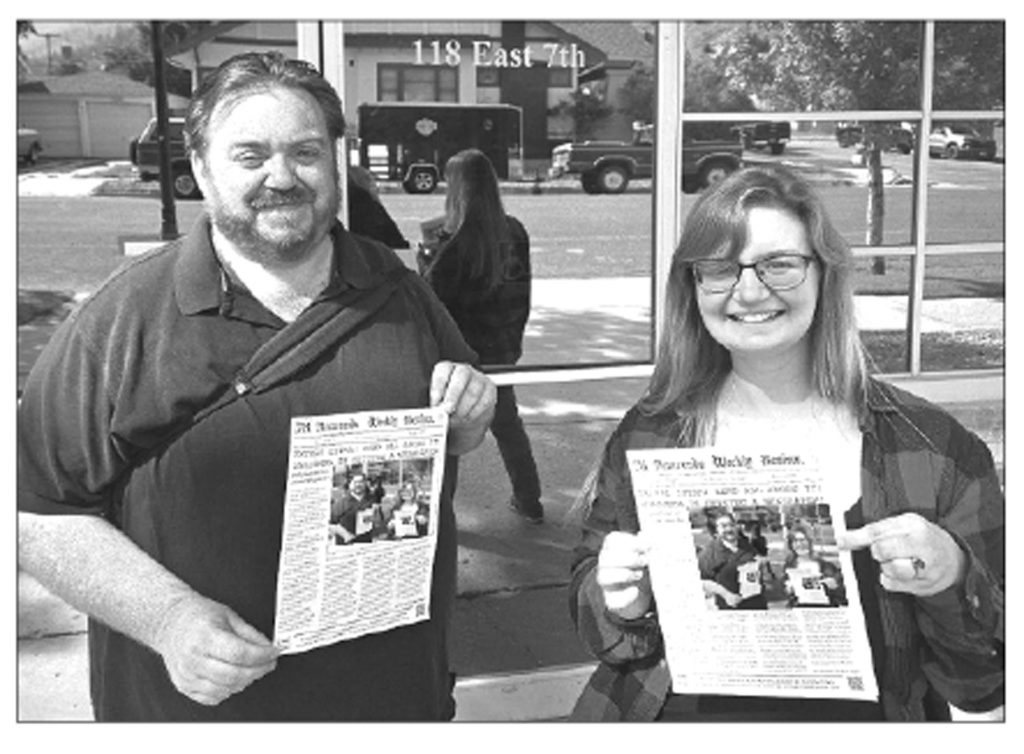
Since the closing of the Anaconda Leader – a family-owned newspaper with a 55-year legacy in the Smelter City – at the beginning of June, one question has permeated the thoughts of Anacondans and others statewide: will the citizens of Anaconda-Deer Lodge County get a local newspaper again?
For some, it wasn’t a matter of ‘if’, but ‘when’. From the day the Leader closed, longtime editor and reporter James S. Rosien was working behind the scenes to start up a paper that could serve the community again, new and improved from the former model.
That paper is the Anaconda Weekly Review, which will deliver the news, in print, to subscribers’ mailboxes on a weekly basis beginning later in September, as well as online at anacondareview.com.
And the new nonprofit, the Anaconda Community Media Company (ACM), will work with Rosien, the Review’s publisher, to ensure that the presses won’t get stopped again.
“I felt that a nonprofit model will be sustainable in that it will last as long as the community would like it to last,” Rosien said. “So, as long as we provide accurate, local information that is factual and relevant to people of Anaconda.”
With the help of Adam Vauthier, who now serves as the chair of ACM’s five-person board of directors, Rosien’s vision for a nonprofit community newspaper began to take shape in a tangible way.
“I decided to help start the paper because Anaconda needs a trusted place to share stories, celebrate local successes, and stay informed about the issues that affect them,” Vauthier said. “Local journalism helps people feel connected and gives residents a greater voice in the future of their community. I believe this paper can become an important resource that is truly rooted in and accountable to Anaconda.”
“The important thing is it won’t rely on a single person for its sustainability,” Rosien said. “It has a structured board, and each member has key areas of expertise, knowledge, skills for this nonprofit to operate, regardless of who ends up running it in the future. We should be able to keep it running for the good of the community.”
In addition to Vauthier, community members Lindsay Jordan, Macy Matosich, James P. Dolan and Steve Hill make up the paper’s inaugural board.
“To be an independent news source that’s still able to reach a wide audience in multiple formats is a challenge, so you need to have a lot of people behind you – a crowd-funded model in a way,” Rosien said. “It takes a village.”
Both the newspaper and its parent company were named in homage to our particular village’s rich history. The Anaconda Community Media Company’s acronym is a nod to the historic ACM, the Anaconda Copper Mining Company, which was foundational in establishing the city of Anaconda. This ACM, however, will operate as a nonprofit corporation for the benefit of the public. To that end, ACM has filed with the Internal Revenue Service for 501(c)(3) charitable status, which is pending IRS approval.
As to the paper operating under ACM’s umbrella, its name was an easy choice for Rosien: a new name, but also an old one. Rosien did his research and found the first paper in Anaconda wore this name, and wore it well. See Page 3 for more on the history of the original Anaconda Weekly Review.
The new Review will depend upon the community for support in a variety of ways, including with its coverage.
“We’ll rely upon our contributors. We hope to have back the ones we had when the Leader was running, and to bring on more,” Rosien said.
Rosien said the paper will have editorial and advertising policies that are consistent with its nonprofit status.
“We have to fulfill our mission and purpose, which is public education, public awareness, local information,” Rosien said. “That means that a lot of political advertising that’s commonplace nowadays, you will not see in our publication.”
The news will be focused on what’s happening in Anaconda-Deer Lodge County, Rosien said, along with associated content from sources external to ADLC but relevant to readers, such as articles from Montana Fish, Wildlife and Parks, MSU Extension, the Departments of Environmental Quality, Natural Resources and Conservation, Commerce, Public Health and the like.
Rosien added that the paper will have space for a crossword puzzle and Sudoku in addition to local news, schools, sports, outdoors, obituaries, history, arts and entertainment, public notices, meeting notices, church notes and the much-loved Stork Reports.
“We’re gonna pack a whole lot of stuff into a small paper,” Rosien said, with a note to readers: “Please don’t expect it to look like the Leader.”
“It’s not a broadsheet with great big pages and great big photos,” Rosien said. “It’s a paper you can hold in your hands, a magazine-style paper. But it will all be local or of local interest, the same stuff that we did at the Leader.”
ACM’s revenue model will rely on subscribers, sponsors and donors. It aims to generate $150,000 a year via subscriptions, and the board’s goal for the first year is to garner 2,000 local subscribers, or roughly 1 in 5 county residents. It also aims to generate at minimum the same amount of revenue via sponsorships (paid advertising content). The Anaconda Weekly Review’s goal is to generate at a minimum $300,000 in annual revenue from a combination of subscriptions, sponsorships, donations and grants.
“With the private, for-profit model, I think we can all see from the direction this industry has taken is not conducive to a widespread diverse market in terms of the way that these companies have merged, in terms of how few actual people there are that own the sources of information anymore,” Rosien said. “To make that model work, it’s just like you need to have a tremendous amount of money behind you, and it seems there are only so many people willing to do that.”
Rosien’s comments are supported by a pattern of closures that have appeared in the last several years. When the Leader shuttered unexpectedly, it put Anaconda on a map, and not in a good way. The fact that ADLC no longer had a local paper made it the fourth county in Montana to have met such a fate, effectively marking it as a news desert.
And it’s not just the Treasure State. In 2025, 136 U.S. newspapers closed, part of a steady pace that’s added up to an estimated 650-700 closures over the past five years alone, according to Northwestern’s Medill School of Journalism “State of Local News” project. As a result, 213 U.S. counties now have no local news source at all, and 1,524 have only one, leaving roughly 1 in 7 Americans with limited or no access to local news.
Montana reflects this national crisis closely. Three of the state’s 56 counties have no newspaper at all, and 35 have only one remaining local news source, meaning more than two-thirds of Montana counties are news deserts or down to a single outlet. In just the past year, the state lost the Havre Weekly Chronicle, the Valley Journal in Ronan, and – shortly after the Anaconda Leader’s closure – the Daniels County Leader.
Several of the state’s remaining daily papers, including the Montana Standard, the Missoulian, and the Helena Independent Record, have also cut print publication down to three days a week, leaving the Billings Gazette as Montana’s only seven-day print newspaper.
Rosien said the first edition later next month will be a big one, filled with coverage of events that happened throughout the summer, in addition to the news of the day.